Joan Agnes Njambi Matimu, ISMC
Consolata Missionary Sisters and Synodality
1. Introduction
Consolata Missionary Sisters is a missionary congregation founded by St. Joseph Allamano in 1910 in Turin, Italy, 8 years after he had founded the Consolata Missionary Fathers and Brothers. Currently we are 460 members coming from 15 nationalities and present in 18 countries on 4 continents. In a nutshell, our charism is evangelization of the non-Christians.
The values that St. Joseph Allamano1 passed on to his sons and daughters are a key to understanding how we, the Consolata Sisters, are called to incarnate the Church’s call to communion, participation and mission. What follows is a brief (and poor) reflection of how the Consolata M. Sisters live synodality today. More importantly, it is an endeavour to give voice to a dream we cherish as individuals and as a Congregation: to allow the ideals of our Father Founder and the synod values to come alive and find expression in our lives and Mission.
2. Communion, Participation, and Mission
St. Joseph Allamano left a spiritual legacy of great relevance for the contemporary Church. His life and teaching offer significant insights for understanding and living the synodal journey, which is a call to listen to the Holy Spirit and the people of God and is characterized by some fundamental aspects in his spiritual life: union with God, continuous journey of conversion, life of prayer rooted in the Eucharist, discernment, and devotion to Our Lady.
From the very beginning of our religious family, Allamano was prophetic in what it means to be synodal. A good example is the methodology he used in the formation of the first groups of missionaries. Under his request, every evening before retiring, the missionaries (Fathers, Brothers, and Sisters) would gather together in order to evaluate the day's activities and program for the following day. The content of these candlelight meetings would then become important formation material for the new generations of missionaries. Though less frequent today, this practice is still part of the Consolata tradition, especially in the new missions. The participative communion for Mission is for us an ideal that we seek and prioritize as a missionary family.
Synodality requires active and shared participation, where each person is valued and respected in his or her role. One of its central aspects is, precisely, the co-responsibility of all the baptized. St. Joseph Allamano promoted an ecclesial vision in which priests, religious, and laity would work together, each with their own role and charism. He encouraged the formation and active participation of all, aware that the mission of the Church cannot be carried out by a few but requires the commitment of the whole People of God. The last 30 years has seen the birth of Consolata Lay Missionaries who live our charism and participate with serious commitment in the Mission of the Church.
3. The Synod: An Emphasis of The Consolata Charism and Mission
The final message of the synod is a wake-up call for us today to rediscover and live up to these prophetic ideals proposed to us by our Founder. The final document emphasizes very fundamental values, some of which were given to us by Allamano and along the years, they have become central to our identity and Mission today.
3.1 Call to Holiness
At the centre of the synod’s final document is the call to holiness through continuous conversion directed to every baptized2, a condition without which the church cannot bear witness to Christ’s saving love. In the teachings of St. Joseph Allamano, holiness and Mission were the two sides of the same coin and are perfectly found in the journey of the synodal church today. “Saints first, then Missionaries” was the motto he gave us.
He often said, “You have to be saints, great saints!” This call to concrete holiness implied a life lived in daily fidelity, rooted in prayer, humility, and service. For him, holiness implied the commitment to live the Gospel fully and authentically every day. Regarding us Missionaries, he said that the main purpose of our Institute is our sanctification and then the mission.
Even today, the Consolata Sisters are called and committed to the journey of holiness, without which they cannot be authentic missionaries. On the 20th October 2024, during the 2nd session of the Synod, specifically on Mission Sunday, Joseph Allamano was canonized, thus confirming the charism passed on to us, that is, Mission through holiness.
Holiness is not just a personal affair, nor is it just the fruit of an individual journey. Just as mission tends to communion with God and with one another, so holiness of life is nourished by communion and leads to communion. This ideal was dear to Allamano and is central to our identity and mission. In order to immerse ourselves in this grace-filled moment of his canonization, the Consolata Family (Fathers, Brothers, Sisters and the Lay missionaries), has dedicated a year to the theme of Holiness, until 16th February next year, when we celebrate the Centenary of his birth to heaven. We are having a monthly reflection on aspects of holiness that Allamano proposed to the first missionaries, applying it to our reality of today.
3.2 Commitment to Mission
The mission was and is the core of the charism of St. Joseph Allamano. He saw in mission the concrete expression of Christian charity and the proclamation of the Gospel. By founding two missionary Institutes, he dreamt of bringing the Consolation of Mary, that is, Jesus, to the most remote places in the world where He is not yet known and loved – Mission Ad Gentes. He affirmed that an authentic Christian cannot keep the gift of faith for himself but must share it with those who do not believe in him yet. His vision of mission, moreover, is not limited to the proclamation of the faith alone but includes the promotion of human dignity. He wanted our congregation to be exclusively missionary and wanted missionaries who were “issimi” (literally translated as “very”) in everything. He wanted us saints, not so as to remain in a niche, as he used to say, but for Evangelization.
We have heard it over and over again that the Synod has only one Mission: Evangelization, and this Mission has guided and continues to illumine the journey of synodality. In the synodal Church, the concept of Mission becomes even more relevant because evangelization is not a task of priests and the religious but involves the whole people of God. This calls for witness of the faith in everyday life and engaging in social justice and intercultural - interreligious dialogue.
As a missionary congregation, we feel more than ever the need to commit ourselves to this mission of the Church through.
Direct evangelization: Like St. Paul, we are called to explicitly proclaim the Word in and out of season, through words and actions.
Witness through life: In some of our mission presences, especially among the Muslims, we cannot talk about Christ, but through witness, we become “the Perfume of Christ’s love” among our brothers and sisters. Consequently, mission means readiness to lay down our lives for the sake of the Gospel. Blessed Leonella Sgorbati, martyred in Somalia in 2006 and beatified in 2018, is a humble model of Evangelization through witness, up to the last consequences.
Mission as Relationship: Humane and humanizing relationships are the highway to evangelization; hence, they are an indispensable component of our community living and pastoral activities.
Mission as Human Promotion: Allamano considered human promotion as the first step towards Evangelization. In fact, in all our missions, our first activities include learning the language of the people and attending to the basic needs of the people: education, health programs, women promotion, etc.
3.3 Eucharistic for Mission
Allamano considered the Eucharist not only as a source of personal grace but also as the core of mission and ecclesial communion. While forming his Missionary Daughters, he often expressed this desire: “I want you to be Eucharistic; I want you to be Blessed Sacrament Missionaries.” For him, the encounter with Christ in the Eucharist nourishes apostolic fervour and strengthens the unity of the Christian community. He thus invited his missionaries to a profound Eucharistic life.
For the journey of synodality to be authentic, it must be rooted in an intense Eucharistic life, where the love received from Christ is translated into service and fraternal sharing. The synodal Church finds in the Eucharist the strength to walk together, nourished by Christ to become bread that is broken and shared for the world. “The Eucharist, the source of communion and unity, continually nourishes the People of God on their journey towards the Kingdom: ‘Because there is one bread, we who are many are one body, for we all partake of the one bread.’ (1 Cor 10:17)”.3
In our Institute, the Eucharist is one of the fundamental charismatic values. In one of our documents of proper law it is indicated: “the Eucharist is the fire, the heart that beats and nourishes the passion for God and for the mission. In the Eucharistic Christ we experience the saving love and consolation.”4 We believe that love for the Eucharist guides and sustains us until we become bread that is broken and shared to all. Allamano always lived of the presence and in the presence of Jesus, and he wants us to be Eucharistic women. The Eucharist sustains us to give our lives as a burnt offering just like our first Sisters. Daily personal and communal Eucharistic Adoration are a common practice in most of our communities. Furthermore, the Communities of elderly and Sick Sisters have continuous Adoration everyday as their way of accompanying and sustaining those in active missions.
3.4 Communion and Co-Responsibility for Mission
Allamano used to tell the first Missionaries that since the Institute is one body only with a common vocation, it must have only one spirit, just like the soul in the human body. There must be a common commitment to preserve this unity of spirit.
He wanted us to live family spirit and an authentic fraternity, where each one feels part of a single body. He promoted a deep sense of community, both within our Institutes and in our relationship with the population we are called to evangelize. He valued the contribution of each one, noting that mission is not the work of individual heroes but of a Church that walks together in communion.
Communion, as understood, lived and taught by Allamano, manifested itself as:
Authentic and fraternal relationships between the members of the community, thus becoming a community that evangelizes through witness.
Mutual listening and appreciation of each other's gifts.
Sharing the mission in a dynamic of mutuality, where each person, including the non-Christian, has something to offer.
This vision anticipates the current synodal journey of the Church, which places discernment at the centre as a fundamental attitude of the ecclesial community and is expressed in the ability to listen to the voices of all, from the laity to the consecrated, from the young to the elderly, to build together a Church family of God that is open and always "going forth." In fact, the synodal principle of communion suggests that the Church is not a rigid hierarchical structure but one body, a family, a people on a journey, animated by the Holy Spirit.
3.5 Spirituality of Listening and Discernment
St. Joseph Allamano embodied a profound capacity to listen, both to God and the needs of the people. He taught that to be authentic disciples of Christ, it is necessary to be in harmony with the Holy Spirit, letting oneself be guided in discernment in order to understand God’s will.
The invitation to active listening and discernment is fundamental to the synodal process, which requires attention to the different charisms and voices of all, especially the marginalized. Allamano always emphasized the importance of inner listening and docility to the Holy Spirit. “It is not we who decide but God. Our task is to listen, discern, and then act” he used to say. He exhorted his missionaries never to act alone but to confront, pray, and discern together in an attitude of humility and trust in Providence.
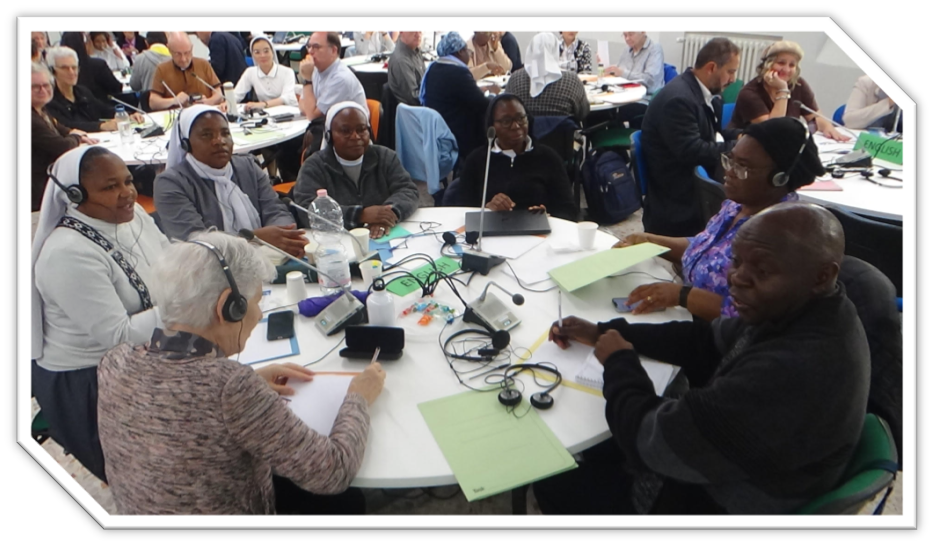
Today, more than ever, we feel called as individuals and as a religious family to incarnate those family traits ingrained in us by Allamano. Community discernment, which includes prayer, mutual listening, and dialogue, is part and parcel of our decision-making processes, where the participation of all members, from oldest to youngest, is valued. Extended Council assemblies are spaces where the General Leadership engages those in various levels of authority, in dealing with important issues affecting the congregation, or the implementation of certain decisions.
In the last 20 years, there has been more involvement and participation of all members of the Institute in the preparation and implementation of General Chapters. This has seen us intensify the process of journeying together especially as we renewed the Institute’s main documents of Proper Law: The Constitutions, General Directory and the Administrative Guidelines. We also realized some new ones: The Ratios Formationes (General Formation Plan) and Ratio Misiones (Vision of Mission according to the charism of the Consolata M. Sisters).
In 2022, during an Inter-chapter assembly, we lived through a very beautiful experience of rediscovering and identifying the core values of our charism. We had 40 days of prayer, reflection, and sharing, using the methodology of the Conversation in the Spirit5. At the end of this period we were able to come up with another very fundamental document: The Treasure of our Charism. All these documents have been reflected upon from the grassroots all the way to General Chapter Assemblies. Each member of the congregation has an opportunity to actively participate, thus strengthening the family bonds and co-responsibility in the implementation of the documents. This is in line with the teaching of the Synod, where every baptized is called to actively participate in the Church, including processes of decision-making through mutual listening, dialogue, and community discernment.6
4. Together with the Universal Church in Mission
Synodality is the walking together of Christians with Christ and towards the Kingdom of God, in union with all humanity, oriented to mission.7 This implies communion and collaboration at all levels of the Church. St. Allamano wanted his spiritual daughters to be “Papaline,” that is, with special love, obedient, and always available towards the Pope.
It's important to note that Allamano never wanted to found a congregation for Women Religious. His missionaries in Africa had experienced some difficulties, some mission needs that were more reserved for women, especially health care for mothers and children. They had requested Allamano to send some Sisters, which he did, through the collaboration of the Sisters of St. Joseph Cottolengo. However, the mission territory expanded rapidly, and so did the need for more sisters, up to the point where the Cottolengo Sisters could not meet the demand. Allamano went to Rome to request a congregation from the Pope, at the time Pius X. The Pope however told him to found his own Sisters and form them according to his vision of mission. He told the Pope that he did not have the vocation to found a women religious congregation, and so the Pope told him, “I give you the vocation.” In faith and total obedience to the Pope, the Consolata Missionary Sisters came into being. For this reason, he always insisted that we owe our existence to Pope Pius X; thus, we must always be available and obedient to the Pope wherever and whenever he needs us.
This filial adherence is necessarily extended to our availability and collaboration with the local ordinaries where we are present. The Synod's final document8 describes perfectly the role that my congregation, like many others, has played in the Church’s mission at the local level. We are active in the life of small Christian communities; we have been given the responsibility of running parishes where no priests are available, e.g., in the USA and in Kazakhstan; we run schools, hospitals, and orphanages.
In many parts of Africa and Asia, we collaborate with the local church in promoting human dignity, social justice and Interreligious dialogue. We contribute to theological research and are present in positions of responsibility in Church institutions, in diocesan curia, and in the Roman Curia…
In some of our missions, we continue to be involved directly in the formation of clergy and lay ministries; for example, in Guinea Bissau, Ethiopia, and Kenya, just to mention a few. In the 120 years of our existence as a congregation, we have been directly involved in the foundation and initial formation of 6 local religious congregations in Africa and Latin America. Our Mission to be a Consoling presence where the Church is young and vulnerable is still valid today.
5. Mission among the Poor
Another central aspect of the charism of Allamano is attention to the poor and the least, which he considered an evangelical priority. In a synodal Church, this sensitivity translates into a preferential option for the poor, listening to their needs and integrating them into decision-making processes. Allamano’s missionary commitment was not limited to evangelization but was also expressed in a concrete concern for human promotion and social justice. In the synodal Church, this dimension is expressed through listening to and welcoming the most fragile voices, the human and existential peripheries. “In the heart of God there is a preferential place for the poor” (EG 197), the marginalized, and the excluded, and therefore also in that of the Church. In them the Christian community encounters the face and flesh of Christ, who, “though he was rich, became poor for our sake, so that we might become rich through his poverty” (cf. 2 Cor 8:9).
One of the criteria for mission is the preferential option for the poor. For us, Mission Ad Gentes implies situations of poverty: material, moral, spiritual, etc., and that is where we feel the Spirit calling us to be instruments of consolation. In all our missions, especially in Africa and Latin America, we have always tried to give back to the people their dignity through services such as education, health, self-sustainability, and promotion of the oppressed, especially women and children.
In the last 20 years, though rapidly diminishing in numbers, we have kept this option as a priority, thus opening new missions in Mongolia, Kazakhstan, Kyrgyzstan, and Uzbekistan, often choosing those areas that are among the forgotten in the Society, sometimes even by the Church.
Prompted by the desire to respond to the real needs of poor and the abandoned, one of our sisters was part of an inter-congregational Mission for children with disabilities in Kabul, Afghanistan, from 2017 to 2021. In order to fight against cultural poverty, in Ali Sabieh, Djibouti, the Sisters initiated a special program for children with disabilities who otherwise were locked up in the houses and sometimes even tied down with chains. Our lifestyle is always an effort to be witnesses of Christ, who became poor in order to enrich us with his life and love.
6. Mission under the Patronage of Mother Consolata
Synodality is a spiritual process of listening, discernment, and communion, guided by the Holy Spirit, with Mary as a journeying companion, one who lovingly shows and guides the way9. She is the icon of communion, of discernment, of faith and mission, the one who teaches us to guard the Word and to walk with trust even in difficulties. Entrusting oneself to Mary means learning to live synodality with love, patience, and a spirit of service. These are some of the values we feel called to incarnate.
St. Joseph Allamano founded our Religious Institute under the patronage of the Virgin Consolata, seeing consolation as an essential mission of the Church.10 In a synodal perspective, the Church is called to be a community of consolation and hope, capable of welcoming the wounds of humanity and offering the balm of God's love. Allamano had a deep devotion to Mary Consolata. He saw in her the perfect model of faithful listening, service, and availability to God's will. Allamano gave us Mary Consolata, not only as a name but as a model to imitate. He told the first Missionaries: “You have to live up to the name you carry.” Hence every Consolata Sister is called to incarnate the traits and values Mother Consolata presents.
7. Conclusion
The Synod on Synodality is one of the greatest legacies left us by Pope Francis. At the same time, we feel it's not just a legacy from the Pope; it is a heritage we all are part of, and can easily identify with, given that it is fruit of the commitment of the whole body of Christ. The Holy Spirit has called forth from within us the ideals we all desire to live in order to be more of a Church where all can feel they belong and are part of the journey towards the Kingdom. It’s a shared mission where we all have an active role.
It's important that we maintain the healthy tension between where we actually are and where we desire to arrive: ‘the “already” and the “not yet”. This is our dream as Consolata Sisters. In a way, we are already implementing the insights offered to us by the Synod. However, we are not yet there. Through the guidance of the Spirit who makes everything new, together, our journey continues.
Basically, all the references to the teachings of St. Joseph Allamano are taken from his Spiritual Conferences given to and written down by the first groups of Consolata Sisters in the period between 1910 to 1925.
XVI ORDINARY GENERAL ASSEMBLY OF THE SYNOD OF BISHOPS, For a Synodal Church: Communion, Participation, Mission. Final document. Rome, 26 October 2024, nn. 5, 15. (Henceforth referred to as Synod Final Document).
Cfr. Synod Final Document, n.16
Consolata Missionary Sisters, Acts of the Inter-chapter, 2022, p.19, n.2
Synod Final Document, n. 45
Ibid., n. 25, 28
Synod Final Document, n. 28
Synod Final Document, n. 60
Synod Final Document, n. 155
ALLAMANO G., Cfs, Vol. I, 64. ... you must be the consolation of the Church, of your superiors who want only your good; otherwise, what regret would I not have on the day of Judgment if I had to say: I got so tired, and then they did not respond.